
Forsyth County’s Wanted Catalog
Start with the FCSO Wanted Persons catalog, the sheriff's official listing of people it is seeking. The current address lives on forsythsheriffnc.policetocitizen.com. Older links, such as the legacy `p2c.fcso.us/mostwanted.aspx` and `wantedlist.aspx` pages, still float around search results, but treat those as historical leads rather than working endpoints. Because the live catalog changes on its own schedule, with entries added and cleared over time, assume no fixed count.
One narrow question gets answered here: has the Sheriff's Office chosen to publish this entry? It is not a full warrant database. A missing name proves nothing, since warrants, indictments, and criminal summonses can still exist elsewhere. Under N.C. Gen. Stat. § 132-1.4, returned arrest and search warrants, indictments, and summonses can be public records unless sealed or restricted. Even so, a court search has its own gaps.
When an entry shows a photo, treat it as an identification aid. Read it alongside the date, the listed offense or process, identifying details, and any agency contact the entry provides.
What the Wanted Entry Shows
Open the full official record rather than trusting a search snippet. Entries shift as people are added, cleared, or removed.
| Field | Meaning and limit |
|---|---|
| Name | The person named by the agency. Confirm identity through official contacts. |
| Photo | A possible identification image. |
| Offense or process | The alleged basis for the request, which may not show the full court history. |
| Description | Physical or other identifying details supplied by the source. |
| Agency or contact | The office that can receive information. It is not permission to confront anyone. |
| Publication status | A changing public entry, not proof that a warrant remains active at every moment. |
Charges and process change. A listing can be cleared once a person is located, arrested, or served, yet it can also linger while the court record moves on. The court's later disposition controls the legal outcome.
For a second visual source, the Kernersville Police Department wanted page is a city list, separate from the FCSO catalog.
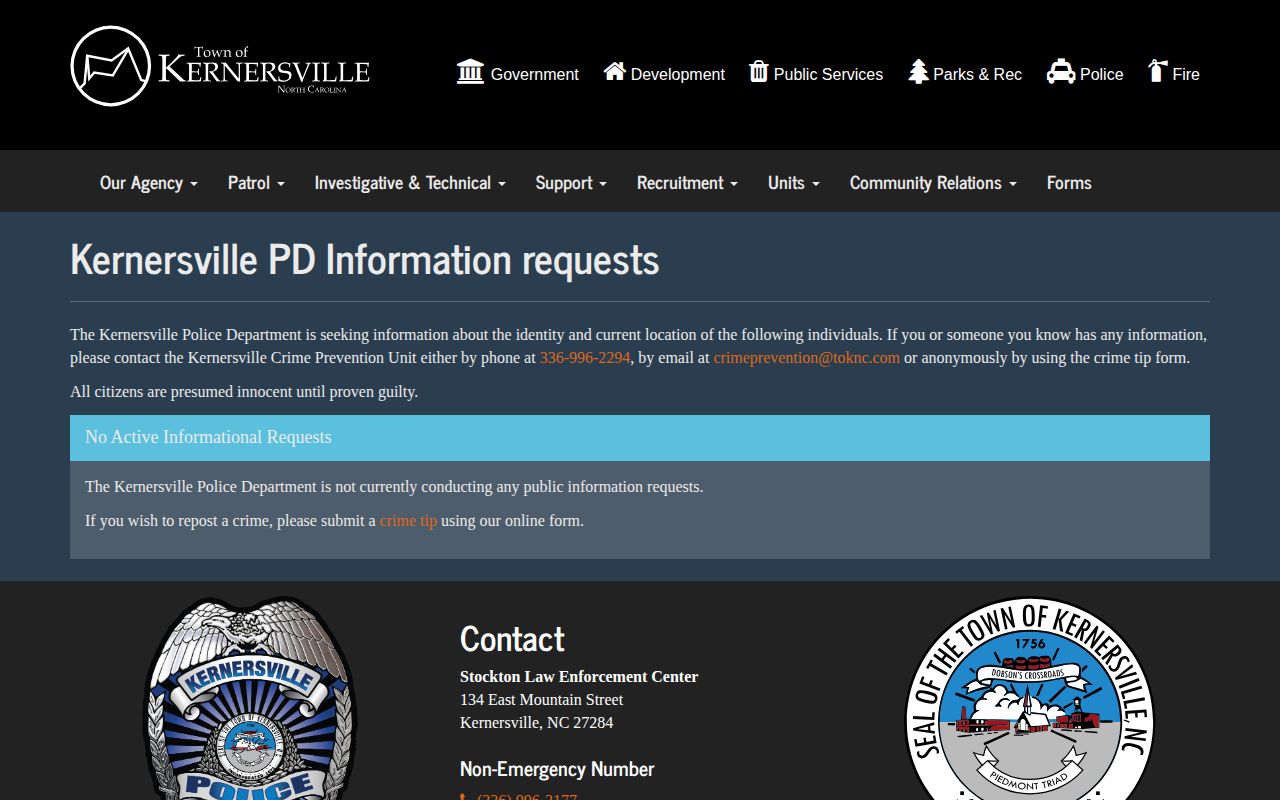
That capture explains why the KPD list stays separate from the sheriff's. It is not a gallery or a stand-in for the current FCSO catalog.
How to Read the List Safely
Treat the catalog as a source check, not an invitation to investigate a neighbor or confront anyone.
- Open the current FCSO wanted catalog and confirm that the page is for Forsyth County, North Carolina.
- Read the full entry, including the name, alleged offense or process, identifying information, and agency contact.
- Compare a possible match with official court or agency information. Do not rely on a name or photo alone.
- If you have information about a listed person, use FCSO’s official tip route or Crime Stoppers.
- If the entry may concern you, contact an attorney, the court, or the issuing agency using official contact information.
Never approach, follow, photograph, threaten, or try to detain someone on a wanted list. Call 911 if there is an immediate emergency. A tip channel exists to share information about an investigation. It is not for asking whether someone is held at the LEDC.
Forsyth Tips and Crime Stoppers
FCSO's Real-Time Intelligence Center takes anonymous photo, video, and text tips through its Text-A-Tip line at 336-920-8477. The RTIC page notes that you choose how much to share. The agency screens each tip. This channel serves investigations. It is not a custody lookup, a roster alert, or a warrant certificate.
Winston-Salem Crime Stoppers offers another official route. Its Crime Stoppers page lists 336-727-2800, a Spanish line at 336-728-3904, an online form, anonymous code procedures, and rewards that can reach $5,000. Rewards follow program rules. They are never promised for every tip.
Information channels
FCSO RTIC Text-A-Tip
336-920-8477
Winston-Salem Crime Stoppers
336-727-2800
Spanish: 336-728-3904
Use the official pages for current instructions.
The sheriff's official social accounts can share public-safety news, but no recurring "Warrant Wednesday" feature exists. Social posts are not a complete wanted catalog.
Wanted Listing or Actual Warrant?
The distinction matters. FCSO's catalog confirms a sheriff-published entry. eCourts or the Clerk may show a public case or process record. Neither source works as a minute-by-minute warrant guarantee.
| Question | Useful route | Do not assume |
|---|---|---|
| Is someone on the sheriff’s public list? | FCSO Wanted Persons catalog | That the catalog includes every warrant. |
| Is there a public court process? | North Carolina eCourts and Forsyth Clerk | That every sealed or restricted item will appear online. |
| How should a possible warrant be resolved? | Attorney, court, or issuing agency | That self-contact or self-surrender advice can be improvised. |
The Forsyth County Clerk of Superior Court handles court-record questions at 336-779-6300. FCSO's general line is 336-917-7001. Ask which office holds the record. Ask what process currently applies. Report a blank online result as "not confirmed," never as "no warrant."
Common Process Terms
Terms can overlap in casual speech, but the source record controls the label.
- Arrest warrant
- A judicial or authorized process that allows an arrest based on the stated legal grounds.
- Search warrant
- Process authorizing a search under its stated scope and conditions.
- Criminal summons
- A command to appear in court rather than an automatic instruction to take a person into custody.
- Failure-to-appear process
- A later court or agency action tied to a missed required appearance.
- Wanted listing
- A public agency notice seeking information or locating help, not a complete court record.
Do not treat a posted charge as a conviction. The person named in a wanted entry remains presumed innocent unless and until a court determines otherwise.
How to Check a Forsyth Warrant
For a specific person, run a layered check and keep each result in its proper category.
- Search the FCSO Wanted Persons catalog for a current sheriff-published entry.
- Search the Forsyth County location in eCourts by exact name, case number, or available date filters.
- Call the Forsyth Clerk at 336-779-6300 when the online record is incomplete or a certified route is needed.
- Call FCSO at 336-917-7001 for agency routing, not for a promise that a blank search clears a person.
- If the process may concern you, speak with counsel or the issuing court before taking action.
The Forsyth County booking-record search can show county custody when someone is booked at LEDC, but a wanted entry and an inmate entry answer different questions. A person can be wanted while absent from the current roster, or sit in the roster without ever appearing on the curated wanted list.
When a Wanted Status Changes
A wanted listing is a moving target. The sheriff's catalog can drop an entry at any moment, and the reasons vary. Maybe deputies found the person. Maybe they made an arrest or served papers. Sometimes the record simply needed a fix, or the office chose to pull the notice. When a name vanishes, that tells you nothing firm about the case either way.
So keep your own trail. Save the official catalog address if a listing matters to you. Then check with FCSO or the issuing court about where the process stands today. Never identify someone in public off a copied photo or an old social media post. Those habits cause real harm, and the underlying record may have moved on long ago.
The court file is where outcomes live. North Carolina's record can show a dismissal, a plea, a reduced charge, or a conviction. None of that appears in the wanted catalog. For county custody, the FCSO LEDC roster is its own snapshot. State sentences run through NCDAC. BOP and ICE cover federal and immigration custody. Each source answers a different question, so treat them as separate doors rather than one combined system.
Do Not Read Silence as Clearance
Silence is not clearance. When a wanted entry disappears, the likeliest explanation is a publication choice, not a final ruling from a judge. FCSO might have pulled the notice after locating someone or fixing a record. There is also a wrinkle worth knowing: a person can be named in court process that never touched the curated catalog at all.
Track these sources in separate columns. The sheriff list tells you what is being publicized. The Clerk's case record shows what the court has filed. The LEDC roster reflects who is in county custody right now. The state DOC search becomes relevant only after a sentence, and federal or immigration locators follow their own rules entirely. Use them for your own understanding. Do not use any of them to confront a neighbor or to judge a face from a photo.